5x5x5 BLD with U2/r2/m2/OP
Prereqs
You must first understand the tutorial for 4x4x4 BLD before reading this page.
We also need to understand the notation of 5x5x5 pieces.
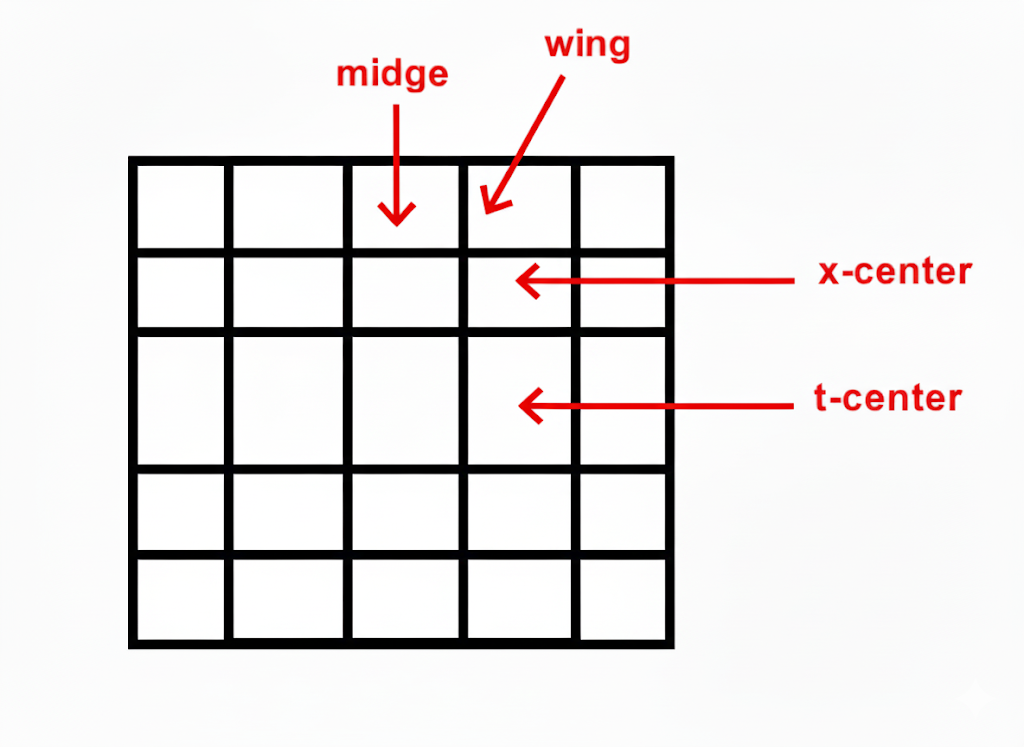
We categorize pieces (ignoring axis center) into:
- Corners
- Wings: Same as classic terminology
- Midges: Edge piece in the center
- X-centers: Centers forming a X shape together with the axis center
- +-centers: Centers forming a + shape together with the axis center
Introduction
We decompose solving a 5x5x5 blindfolded into the following steps:
- Memorize the corners
- Memorize the wings
- Memorize the midges
- Memorize the + centers
- Memorize the X centers
- Solve the X centers
- Solve the + centers
- Solve the midges
- Solve the wings
- Solve the corners
The execution order has to be center -> wing and midges -> corner, because corners will influence both wing (only if parity is involved) and center, and wing will influence center.
The memo order is not critical and can be customized according to your preference.
But it's recommended to put corner memo into longer term memory since it's shorter.
And it's also helpful to let center memo and center execution be close.
There are two major blindfold methods, we introduce U2/r2/m2/OP here. The alternative is 3-style.
Both methods share the same memorization, but differs in execution.
U2/r2/m2/OP is relatively easier to learn and get success. 3-style is conceptually easy but harder to ensure correctness and keep track
of the setup/reverse moves.
Corners and Midges (Same as 3BLD M2/OP except for parity treatment)
The solving method of corners and midges are same as 3BLD with M2/OP method.
For example, to solve a cycle of DF midge -> FR midge -> BL midge, you may do:
- U R U' m2 U R' U' where m2 is the middle slice move
- U' L U m2 U' L' U
Recall you will do the same algorithm for 3BLD M2 method except that M2 in 3x3x3 is now m2 in 5x5x5.
Although the memo and execution is identical to 3BLD, parity needs a minor tweak.
One important property is that, similarly to 3BLD, the corner parity and midge parity either both occurs or both doesn't.
You must solve midges before corners when there is parity.
To solve a parity:
- Solve all the midges with m2 method, including the single letter midge. This will have all midges solved, but the mid slice offset with m2.
- Apply the same parity algorithm as M2/OP, which is D' L2 D m2 D' L2 D. This algorithm will correct the mid slice offset while swapping UL and UB midge (note the wings are not swapped).
- Solve all the corners with OP method, including the single letter corner. This will have all corners solved, while swapping UL and UB's both midges and wings.
- The outcome of previous step is only UL and UB wings got swapped, because midges are swapped once by the parity algorithm, and another time by OP corner. Apply this final algorithm to fix the whole cube: U2 R U R' U' Rw2 F2 U2 r2 U2 F2 Rw2 U R U' R' U2
Wings and X-centers (Same as 4BLD U2/r2)
Wings are completely identical to 4BLD r2, with the same parity algorithm (applied when the r2 slice is offset by r2): r' U2 r U2 r' U2 x r U2 r U2 r U2 r2 U2 x' r' U2
X-centers are also completely identical to 4BLD U2.
+-Center
The main difference of 5BLD and 4BLD + 3BLD edge, except for the special parity algorithm above, is the +-center.
But +-center is easy to capture because it's also using U2 method, which is the equivalent of U2 for X-centers, except the algorithm is now for +-centers instead.
We made the tutorial interactive, where you may specify your letter scheme for +-center.
Up |
|||
Left |
Front |
Right |
Back |
Down |
Algorithms
With the same idea, UL is the buffer piece, UR is the target piece, each time you will apply an algorithm to move the active piece to target piece, do U2, and reverse that algorithm.
Notice that if you see UB/UF piece as the second in letter pair, you need to apply the algorithm for the other one.